
The Razorback Greenway is one of Northwest Arkansas’s defining public spaces for its reach and its intentional design as a living corridor. Stretching 40 miles and connecting seven cities, it has become synonymous with active transportation, outdoor recreation, and thoughtful community design. It operates as both infrastructure and framework: shaping how neighborhoods take form, how housing integrates with landscape, and how growth is directed rather than dispersed.
Central to that effort is Blockwright’s leadership on the Razorback Greenway Corridor Plan, which establishes a cohesive vision for how the trail and its surrounding communities evolve together. The plan’s recognition with a 2026 Charter Award from the Congress for the New Urbanism underscores that distinction.
The corridor plan was created for the Northwest Arkansas Regional Planning Commission in partnership with Field Operations. Blockwright worked as a housing consultant, managing urban design, and innovating how new building types can transform the greenway, while Field Operations managed the regional design framework.
The Greenway’s origins trace back to the 1990s, when local planners and community advocates began to imagine more than connectivity. Early segments in Fayetteville proved that trails could do more than move people–it could organize development patterns, influence land use, and elevate the public realm.
What emerged over time was not just a continuous path, but a coordinated design effort across jurisdictions. Blockwright’s work on the corridor plan builds on that foundation, aligning public investment, private development, and community priorities into a clear framework for growth along the trail.
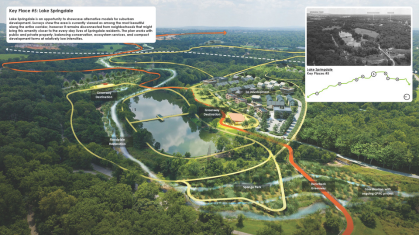
Today, nearly half of Northwest Arkansas’s residents (more than 230,000 people) live within a short walk or bike ride of the Greenway. That proximity has reshaped daily life, but more importantly, it has redefined what it means to live along a piece of infrastructure. Through the Corridor Plan, Blockwright identifies and guides housing opportunities along the trail, focusing on compact, walkable, missing-middle housing that can thrive within the corridor’s unique conditions. With more than 60% of the Greenway located within the floodplain, this work requires a deliberate design approach that treats constraints as opportunities by integrating resilient building types and adaptable site strategies.
The Greenway Corridor Plan is a clear expression of transect-based planning in practice. Its design shifts with context: expanding into preserved natural systems in rural stretches, tightening into activated edges and mixed-use neighborhoods in urban areas, and consistently reinforcing the relationship between housing, mobility, and place. Living along the corridor is an intentional design outcome. Front doors face the trail. Public spaces are embedded within it. Neighborhoods are organized around access to it.
What the Razorback Greenway ultimately demonstrates is that infrastructure can do more than connect destinations. It can determine how housing is built, where density belongs, and how communities grow over time. Through Blockwright’s vision for the corridor, that potential is made explicit, providing a clear, design-driven framework that guides how the Greenway evolves and ensuring that future growth along the corridor is intentional, resilient, and rooted in the experience of living there.